Guests
Not Vital, Steven Holl, Yoshiharu Tsukamoto ‘Bow-Wow’

Curator
Giulia Ricci

Interviewer
Amélia Brandão Costa, Giulia Ricci, Rui Pinto

Photographer
Ivo Tavares Studio

Movie
Ivo Tavares studio

Hosts

Faculdade de Arquitectura da Universidade do Porto

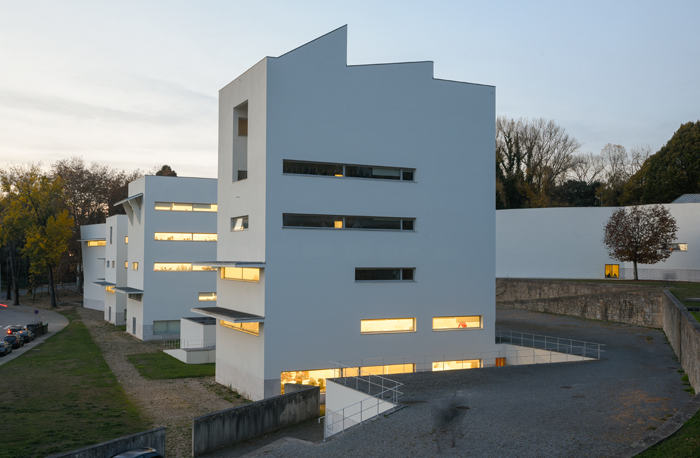
‘The Faculty of Architecture of the University of Porto (FAUP) works on a building designed by Álvaro Siza. “Porto school”, as it is internationally recognized, it’s a worldwide reference in Architecture graduation. On this institution, many awarded and published architects have studied and taught. Fernando Távora, Álvaro Siza, Nuno Portas, Alexandre Alves Costa, Domingos Tavares and Eduardo Souto Moura are some of the greatest examples of the pedagogic, scientific and artistic abilities of Porto school.’

by José Manuel Rodrigues, Director of FAUP master degree in Architecture

sigarra.up.pt/faup/pt/web_page.Inicial
Studios

Not Vital

Not Vital (b.1948) is from the mountain village of Sent, located in the Engadin valley (Switzerland). He currently lives and works in Rio de Janeiro, Beijing, and Sent. Vital studied art in Paris and Rome before moving to New York in 1976. He is an unconventional sculptor in many ways, not least because he also produces extraordinary prints, drawings and, (since 2009) paintings.
Vital leads a nomadic life, and this directly influences his work, as he often engages with local materials and craftsmanship. For example: in Murano (Italy) he worked with glassblowers; in Niger with the Tuareg silversmiths; in Bhutan with papermakers, and in Beijing with steel-welders and woodworkers. The subject matter often revolves around animals and nature, yet Vital presents these familiar sights to us in wholly unexpected ways. Since 2000, his practice has expanded to include buildings such as houses, schools, towers, bridges and tunnels, which blur the boundaries between art and architectures. These constructions are permanent structures, many of which can be seen in his sculpture park in Sent – as well as in Belgium, Brazil, Indonesia, Niger and Patagonia.

notvital.com/en

Steven Holl

Steven Holl was born in 1947 in Bremerton, Washington. He graduated from the University of Washington and pursued architecture studies in Rome in 1970. In 1976 he attended the Architectural Association in London and in 1977 established STEVEN HOLL ARCHITECTS in New York City. Considered one of America’s most important architects, Steven Holl is recognized for his ability to blend space and light with great contextual sensitivity and to utilize the unique qualities of each project to create a concept-driven design. He specializes in seamlessly integrating new projects into contexts with particular cultural and historic importance. Steven Holl has been recognized with architecture’s most prestigious awards and prizes. Recently, Steven Holl received the 2014 Praemium Imperiale, the 2012 AIA Gold Medal, the RIBA 2010 Jencks Award, and the first ever Arts Award of the BBVA Foundation Frontiers of Knowledge Awards (2009). In 2012, Steven Holl received the Alumnus Summa Laude Dignatus Award from the University of Washington, and has received honorary degrees from Seattle University and Moholy-Nagy University in Budapest. In 2003 he was named Honorary Fellow of the Royal Institute of British Architects (RIBA). In 2002 the Cooper Hewitt National Design Museum, part of the Smithsonian Institute, awarded him their prestigious National Design Award in Architecture. In 2001 France bestowed the Grande Médaille d’Or upon him, for Best Architect of the Academy of Architecture; and in the same year Time Magazine declared him “America’s Best Architect” for his ‘buildings that satisfy the spirit as well as the eye’. Steven Holl is a tenured Professor at Columbia University’s Graduate School of Architecture and Planning. He has lectured and exhibited widely and has published numerous texts including Anchoring (1989), Intertwining (1996), Parallax (2000), Idea and Phenomena (2002), Luminosity/Porosity (2006), House: black swan theory (2007), Architecture Spoken (2007), Urbanisms: Workin

stevenholl.com
Professors

Not Vital

Not Vital (b.1948) is from the mountain village of Sent, located in the Engadin valley (Switzerland). He currently lives and works in Rio de Janeiro, Beijing, and Sent. Vital studied art in Paris and Rome before moving to New York in 1976. He is an unconventional sculptor in many ways, not least because he also produces extraordinary prints, drawings and, (since 2009) paintings.
Vital leads a nomadic life, and this directly influences his work, as he often engages with local materials and craftsmanship. For example: in Murano (Italy) he worked with glassblowers; in Niger with the Tuareg silversmiths; in Bhutan with papermakers, and in Beijing with steel-welders and woodworkers. The subject matter often revolves around animals and nature, yet Vital presents these familiar sights to us in wholly unexpected ways. Since 2000, his practice has expanded to include buildings such as houses, schools, towers, bridges and tunnels, which blur the boundaries between art and architectures. These constructions are permanent structures, many of which can be seen in his sculpture park in Sent – as well as in Belgium, Brazil, Indonesia, Niger and Patagonia.

notvital.com/en

Steven Holl

Steven Holl was born in 1947 in Bremerton, Washington. He graduated from the University of Washington and pursued architecture studies in Rome in 1970. In 1976 he attended the Architectural Association in London and in 1977 established STEVEN HOLL ARCHITECTS in New York City. Considered one of America’s most important architects, Steven Holl is recognized for his ability to blend space and light with great contextual sensitivity and to utilize the unique qualities of each project to create a concept-driven design. He specializes in seamlessly integrating new projects into contexts with particular cultural and historic importance. Steven Holl has been recognized with architecture’s most prestigious awards and prizes. Recently, Steven Holl received the 2014 Praemium Imperiale, the 2012 AIA Gold Medal, the RIBA 2010 Jencks Award, and the first ever Arts Award of the BBVA Foundation Frontiers of Knowledge Awards (2009). In 2012, Steven Holl received the Alumnus Summa Laude Dignatus Award from the University of Washington, and has received honorary degrees from Seattle University and Moholy-Nagy University in Budapest. In 2003 he was named Honorary Fellow of the Royal Institute of British Architects (RIBA). In 2002 the Cooper Hewitt National Design Museum, part of the Smithsonian Institute, awarded him their prestigious National Design Award in Architecture. In 2001 France bestowed the Grande Médaille d’Or upon him, for Best Architect of the Academy of Architecture; and in the same year Time Magazine declared him “America’s Best Architect” for his ‘buildings that satisfy the spirit as well as the eye’. Steven Holl is a tenured Professor at Columbia University’s Graduate School of Architecture and Planning. He has lectured and exhibited widely and has published numerous texts including Anchoring (1989), Intertwining (1996), Parallax (2000), Idea and Phenomena (2002), Luminosity/Porosity (2006), House: black swan theory (2007), Architecture Spoken (2007), Urbanisms: Working with Doubt (2009), Hamsun Holl Hamarøy (2010), Horizontal Skyscraper (2011), Color Light Time (2012), and Scale (2012). Most recently published is Urban Hopes (2013). Steven Holl is a member of the American National Council of Architectural Registration Boards (NCARB), the American Institute of Architects, the American Association of Museums, the Honorary Whitney Circle, the Whitney Museum of American Art; and the International Honorary Committee, Vilpuri Library, of the Alvar Aalto Foundation.

stevenholl.com
Yoshiharu Tsukamoto

Atelier Bow-Wow is a Tokyo-based architecture firm, founded in 1992 by Yoshiharu Tsukamoto and Momoyo Kajima. The firm is well known for its domestic and cultural architecture and its research exploring the urban conditions of micro, ad-hoc architecture.
Yoshiharu Tsukamoto was born in Kanagawa Prefecture in 1965. He studied architecture at Tokyo Institute of Technology, graduating from his undergraduate degree in 1987. Tsukamoto travelled to Paris to be a guest student at L’Ecole d’Architecture de Belleville (UP 8) from 1987-88 and in 1994 he completed a Doctor of Engineering program at Tokyo Institute of Technology. In 2000 Tsukamoto became an Associate Professor at the Tokyo Institute of Technology and in both 2003 and 2007 he was a Kenzo Tange Visiting Associate Professor in the Department of Architecture at Harvard GSD. Also in 2007 and again in 2008 he was a visiting Associate Professor at The University of California, Los Angeles (UCLA)
Momoyo Kaijima was born in Tokyo in 1969. She received her undergraduate degree from the Faculty of Domestic Science at Japan Women’s University in 1991 and both her graduate (M.Eng.) and post-graduate degrees were from Tokyo Institute of Technology in 1994 and 1999. She was also a guest student at Eidgenossische Technische Hochschule Zurich (ETH) from 1996-1997. In 2000 Kaijima became an Assistant Professor, and in 2009 an Associate Professor, at the Art and Design School of the University of Tsukuba. Like Tsukamoto, in 2003 she was a visiting faculty (as a design critic) in the Department of Architecture at Harvard GSD and between 2005 and 2007 she was also a guest professor at ETH Zurich. In 2010 she was the Architect in Residence at the University of Auckland.
They have produced many publications and architectural theories based on urbanism and design:–Pet Architecture-Behaviourology-Micro-Public Space-Da-Me Architecture-Generational Typology-Void Metabolism

bow-wow.jp/index.html
Partners

Domus

Founded by Gio Ponti in1928, Domus is the Italian brand on architecture, design and contemporary art with the highest international reputation.
Some of the world’s most famous names of architecture have edited the magazine in the past, including Gio Ponti, Alessandro Mendini, Mario Bellini, Dejan Sudjic, Joseph Grima. Steven Hall and Toshiko Mori are the current editors.
Every month, Domus narrates and investigates the architecture and design avant-gardes with a critical mind and special focus on design excellence.
It represents a privileged environment for information and in-depth study for inspired, design-conscious readers. Domus is an inspirational tool and guidance for the evolution of design culture, scientific and aesthetic vision of global design and art communities of architects, designers, enthusiasts and students.

domusweb.it/en

Ivo Tavares Studio

Ivo Tavares Studio is a photography studio specialized in architecture, dedicated to creating images that capture the essence of spaces.

With an approach that combines documentary rigor and artistic sensitivity, the studio works closely with architects, designers, and institutions, contributing to the communication and appreciation of their projects.

The practice of the studio is built on two main pillars: the observation of light as a structuring element of the image and the pursuit of visual narratives that go beyond mere documentation. Each photograph seeks not only to record a building but also to convey the atmosphere, the experience, and the impact of the space on its urban or natural surroundings.

Over the years, Ivo Tavares Studio has consolidated its presence in the national scene, with projects widely published in leading international magazines and platforms. Its work aims not only to promote contemporary architecture but also to expand its cultural reach, strengthening the visibility of Portuguese architectural production worldwide.

ivotavares.net
This website uses cookies to ensure you get the best experience. Please read our Privacy Policy. Ok